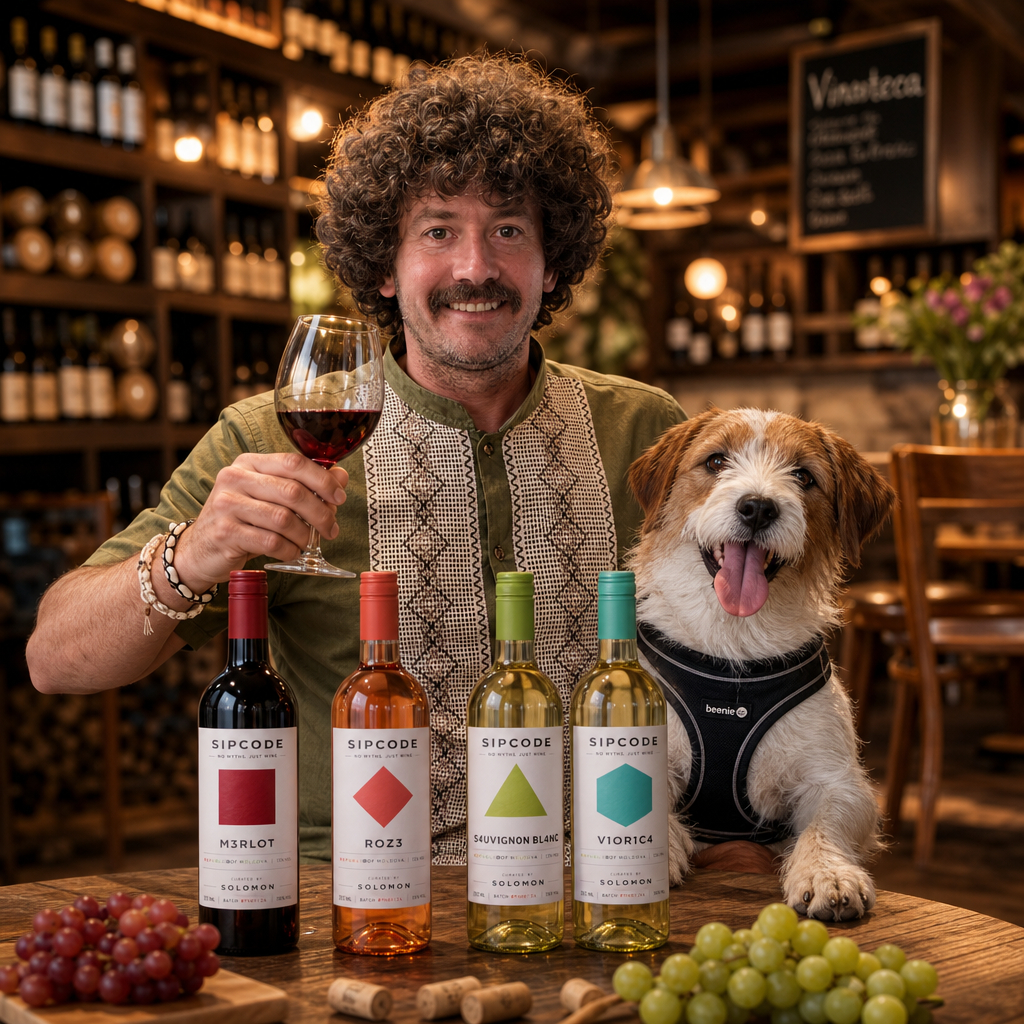
Adrian grew up in Codru, the wine country at the heart of Moldova, where every household made its own. The first bottle he opened ceremonially was at fourteen — a Fetească Neagră his grandfather had laid down a decade earlier, opened the day Adrian's name appeared on a school program. He still remembers the smell. Dried plum, something almost smoky, salt.
Twenty years later he came back to that bottle, then a hundred more like it, with different eyes. A Master's in Oenology taught him how wine actually works — fermentation kinetics, malolactic biochemistry, terroir-as-equation. Two years as Marketing Manager at Purcari, Moldova's most exported winery, taught him how wine actually sells — what people are told, what they're never told, and the gap between the two.
That gap is where SIP C0DE was born.
The decade of tasting
Across ten years in the trade, Adrian has poured, scored, and sat with wines from six countries — Moldova, Georgia, Italy, France, Argentina, Spain. He's been on producer panels in Bordeaux and at small natural-wine fairs in Tbilisi. He's tasted Pinot Noir blind next to French Burgundy and called the difference correctly more often than not.
That kind of mileage doesn't make you better than the wine. It makes you stop being polite. You learn quickly that ninety percent of what's marketed as "premium Moldovan wine" is competent at best, dressed-up at worst. The remaining ten percent — the wines that actually make you stop and pay attention — that's what the SIP C0DE catalogue is.
The 250-person panel
Adrian doesn't taste alone. Across the years he's built relationships with several of the 250 international Wine Experts and professional tasters regularly invited to international competition juries — sommeliers, oenologists, critics. This is the network he leans on when a wine needs a second, third, fourth opinion. Every code-eligible bottle goes through 3 to 5 of them, blind, scored against the variety's tier.
If two-thirds say no, the bottle doesn't earn the code. No appeal, no second chance.
// Why I think they're good"I'd pour any of these for a friend without explaining anything. That's the only test I trust — and the only filter I run a bottle through before it earns a code."
Solomon — Founder & curator
What I look for
Three things, in order:
- 01Character. Does this wine taste like itself? Or is it pretending to be something else — usually a Bordeaux or a Burgundy?
- 02Honesty. Can the producer tell me — without pause — what's in the bottle, where it grew, who picked it, what they did to it? If the story is fuzzy, the wine usually is too.
- 03Consistency. Three random bottles from the same lot, on three different days. They all need to hold. A wine is only as good as its worst bottle.
What I don't do
I don't import wines from outside Moldova. I don't curate "easy drinkers" for events. I don't sell wine I wouldn't drink. I don't accept producer fees to feature a bottle. I don't write tasting notes that sound like real estate listings — "expressive nose, elegant palate, lingering finish" — they tell you nothing.
What I write instead is the only thing I trust: what the wine actually tastes like, in three or four words a friend could understand.